Table of Contents
Introduction
Why is network security very important? Because according to a study by the University of Maryland, there is one attack every 39 seconds and more than 2200 cyber-attacks in a whole day. 560,000 malwares are detected every day, which is a huge figure in cyber-attacks. Understanding why network security is important is critical for every organization.
In today’s digital world, networks are very important for all businesses, whether small or large. Businesses can only communicate through networks. If the network is not secure, companies’ data can be stolen.
To keep our business safe, we need network security to protect our business data, passwords, emails, and financial records before they are stolen, hacked, or leaked.
Ultimately, grasping why network security is important helps organizations prioritize their cybersecurity measures.
What is Network Security?
Network security means keeping your network safe and secure, so that no attacker can attack our network and gain unauthorized access to it, cannot inject any misuse or malicious code by breaking into the network.
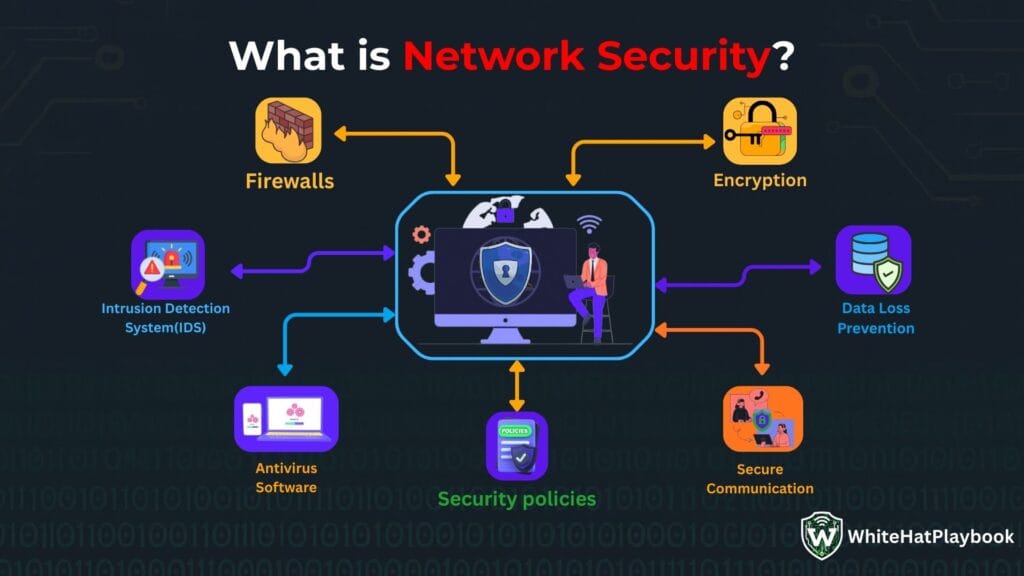
In simple word, network security acts as a digital security guard for our network, protecting it 24/7.
Network security consists of some common network security elements that are used to secure the network:
- Firewall: Although firewalls are a very old tool in network security, they are still considered to be the best, most trusted and popular tools even today. The main function of a firewall is to create a security wall between two networks. It monitors the incoming and outgoing traffic of the network, blocks unauthorized traffic and allows only authorized data and traffic to enter the network.
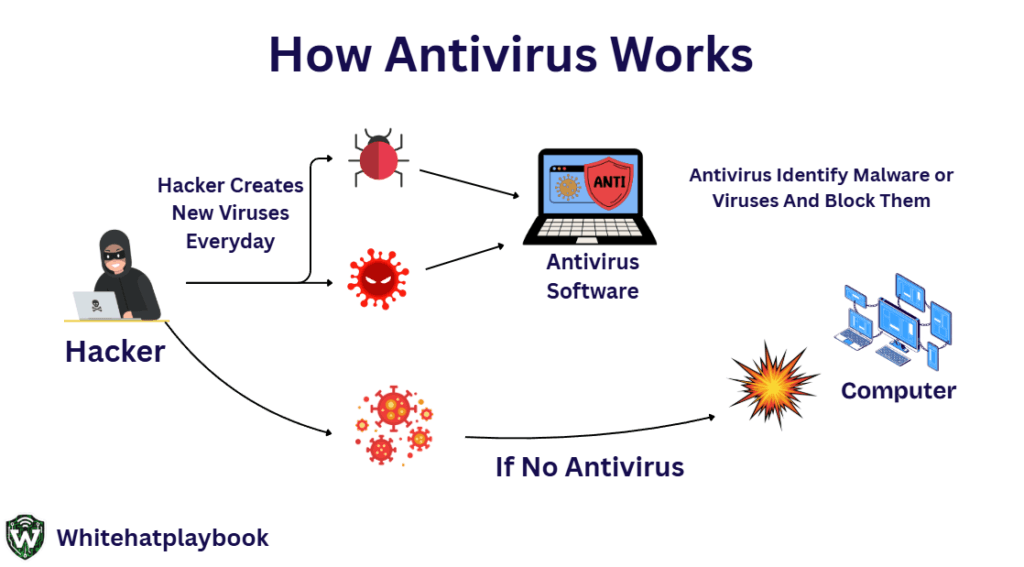
- Antivirus & Anti-malware: Antivirus & Anti-Malware is a software tool that protects the network from viruses, ransomware and malware. These tools detect malicious code or files hidden in our system and network, and block or remove suspicious and infected files and programs.
- VPN (Virtual Privet Network): VPN i.e. Virtual Private Network has become almost mandatory for all online works, freelancers and all those small businesses whose work is going on online these days. It is a trusted communication method which is mainly used for remote access. The main function of VPN is to create a private and encrypted tunnel over the public network. By using VPN our data remains encrypted and safe. It hides our IP address, so that we remain safe whenever we are using public Wi-Fi.
- Intrusion Detection Systems (IDS): The primary function of an Intrusion Detection Systems (IDS) tool is to continuously monitor network traffic. It identifies unauthorized access to the network and generates system alerts, helping to detect suspicious activity within the system and network.
- Access Control: The main function of access control is to decide which resources to grant to a user and how much permission to grant them, so that the user only has the access they need.
Explore how this works in detail in my article : What is Network Security: Beginner’s complete Guides (2026 Edition) – Online Programming Course
Top 8 Reasons Why Network Security is Very Important?
Nowadays, network security is very important for every organization, government and all types of businesses (like small, medium, and big businesses) to keep their sensitive, personal, and financial data and information safe and secure from cyber criminals. Network security makes all these networks strong and secure.
If the network is already strong and secure, companies and organizations can avoid financial losses and reduce the risk of downtime. Network security infrastructure provides multiple layers of protection to the networks of companies and organizations, whose job is to protect the network from malicious and dangerous cyber threats and malware.
- Protect Sensitive Data
- Today, Data is the most important asset for businesses and organizations. Companies’ personal files, passwords, financial records, client details, everything travels through the network.
- If the network is not secure, the chances of data leakage and theft increase significantly. Therefore, it is crucial for companies and organizations to protect and secure their data.
- Prevent and Avoid Cyber Attacks
- These days, cyberattacks aren’t just a problem for large businesses and organizations. They’ve also become a significant problem for small and medium businesses, bloggers, freelancers, and anyone who works online.
- With the help of network security tools, cyber-attacks (like malware, phishing, DoS/DDoS and Man-in-The-Middle attacks) can be detected and blocked.
- Keep Your Clients’ Data Safe and Secure
- Many businesses have data about their clients (such as their bank details, passwords, personal files, sensitive information, etc.). It is important and a responsibility for companies to keep their clients’ data safe and secure so that malicious hackers and attackers cannot misuse it by gaining unauthorized access.
- If companies fail to keep their clients’ data safe and secure, they can lose their reputation and the trust they’ve built. They could also face legal issues.
- Improve Network Performance
- A business can run smoothly if it has a safe, strong, and secure network. This is essential for every business, especially small and medium-sized businesses. Frequent network issues can cost a significant amount of time and money to resolve.
- In simple words,
- strong and secure network connection = smooth business communication.
- Bad network connection = Waste of Time and Waste of Money
- Ensures Business Continuity
- All business communication happens through the network, hence, to run any business continuously, it is important to ensure that the network communication of the business is safe, strong and secure.
- Because if a business network is ever hit by a cyberattack or malware attack, the business could be taken offline, and its website could be down. Businesses rely on the trust of their clients, and that trust can be broken. Businesses could suffer financial losses and even damage their reputations.
- To Avoid Insider Cyber Threats
- Cyber-attacks on our business don’t always come from outside. Sometimes even the smallest of mistakes can lead to a network breach. For example, if we use weak passwords and don’t have two-factor authentication, any attacker can crack that password and gain unauthorized access.
- Therefore, network security ensures that only authorized users have access to companies’ personal data and sensitive information.
- To build trust
- Regardless of the type of business, a business’s reputation and the trust of its clients and users are crucial. If a business’s network communications are disrupted and its network is vulnerable to threats, the brand, reputation, and user trust it has built could be destroyed.
- Therefore, to protect its reputation and user trust, it is important for businesses to make their networks safe and secure by using security measures.
- Cyber-attacks are also increasing along with technologies
- Advancing technologies are a major reason behind the rise in cyber-attacks. As technologies advance, so too do cyber threats due to inherent weaknesses. Today is the era of 5G networks, and very soon, 6G networks will also arrive.
- Some resources have shown that cyberattacks have caused the closure of over 66% of businesses within 12 months. According to the Global Cybercrime Index, Russia ranks No. 1 as the country most affected by cyberattacks. Our country, India, ranks 10th.
- This explains why network security is so important. We can’t ignore it, or it could become a serious threat to us in the long run.
How Network Security Works
Network security is a set of tools designed with a combination of hardware and software tools to protect computer networks, servers, and data from unauthorized access, cyber-attacks, and malware threats.
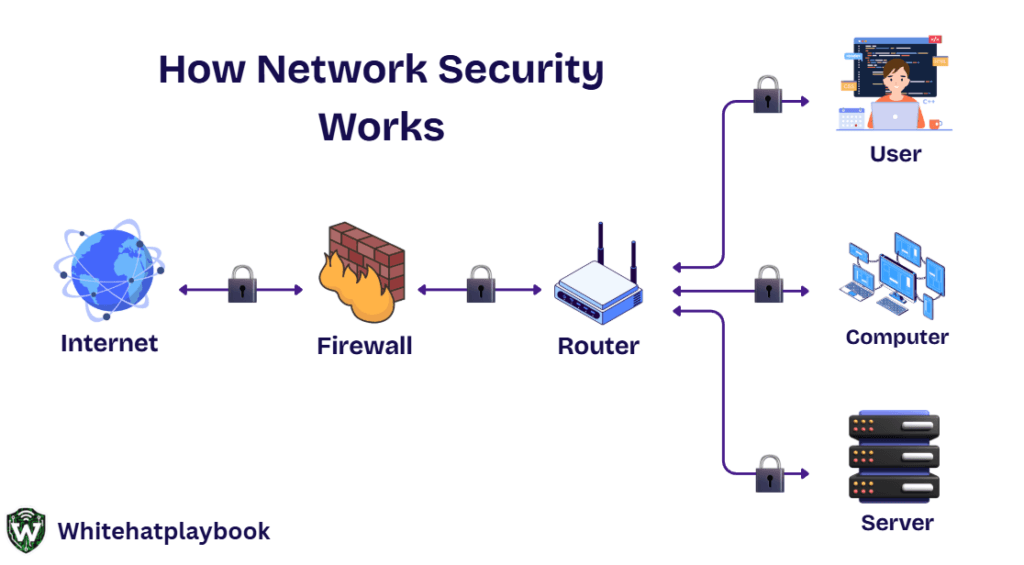
Network security basically works on the Défense-in-depth model, which is multiple security layers. This means that network security is not just a single tool, but a combination of multiple security layers. So that whenever one layer is breached, the other layers protect the network.
- Physical Network Security
- Physical network security refers to the hardware tools used to secure routers, switches, servers, and other components connected to the same network.
- Technical Network Security
- Technical network security refers to the most important software tools. Firewalls, intrusion detection systems (IDS), intrusion prevention systems (IPS), and encrypted virtual private networks (VPNs) are all network security tools that manage network traffic and block unauthorized access or users.
- Administrative Network Security
- Administrative Network Security includes company rules, regulations, and polices. These include password policies, which specify which users should be allowed access and which should not, and rules for data access control. Its main function is to ensure that only authorized users can access the network.
Benefits Of Network Security
- Data Protection: The main function of network security is to keep companies’ important data and sensitive information safe and secure, maintaining the value and reliability of the data so that no attacker can gain unauthorized access or make modifications to it.
- Cyber-attack protection: If our system’s network is not secure, then even a small mistake on our part or an attack by an attacker can completely compromise our system. Network security tools work to protect our system’s network from these cyber-attacks (such as DoS attacks, ransomware, malware, phishing, etc.).
- Ensure business stability: A secure network reduces downtime and ensures smooth business operations and reliable systems, ensuring a stable and continuous business operation.
- Build Reputation and User trust: The brand, reputation, and user trust it builds are crucial for a business. User trust is built when businesses protect their clients’ or users’ personal data and sensitive information (such as bank details, passwords, social accounts, etc.). Network security helps businesses build and strengthen this trust, reputation, and brand.
- Legal compliance: Almost all countries have data protection laws and regulations, such as GDPR (General Data Protection Regulation), PCI-DSS (Payment Card Industry Data Security Standard), and ISMS (Information Security Management Systems). It’s crucial for businesses to comply with these regulations, and network security helps businesses comply.
- Productivity Build Up: The primary function of network security is to reduce the risk of malware attacks and unauthorized access to network systems. This allows company employees to work without fear and without the fear of system or network crashes. In short, network security indirectly increases employee productivity.
- Cost Savings: Network security investments are a bit higher, but the return on investment can prove to be cost saving for a company in the long term. Network security can significantly reduce or even prevent financial losses such as those incurred due to data breaches in the system, legal penalties, and lost business management costs.
Final Thought
In simple words, in today’s digital world, it has become very important to implement network security to make the system and network safe, strong and secure. Without it, the network and system become very risky. Network security protects our network from malicious hackers or attackers, cyber criminals, malware or ransomware and other cyber-attacks.
In today’s time, network security is necessary for everyone, like businesses, organizations, government, freelancers, online works, office works, etc. Network security not only protects our network but also helps in the growth of the business. It also helps the business and organization to build their reputation and trust.
In-short: Strong Network Security = Strong foundation